
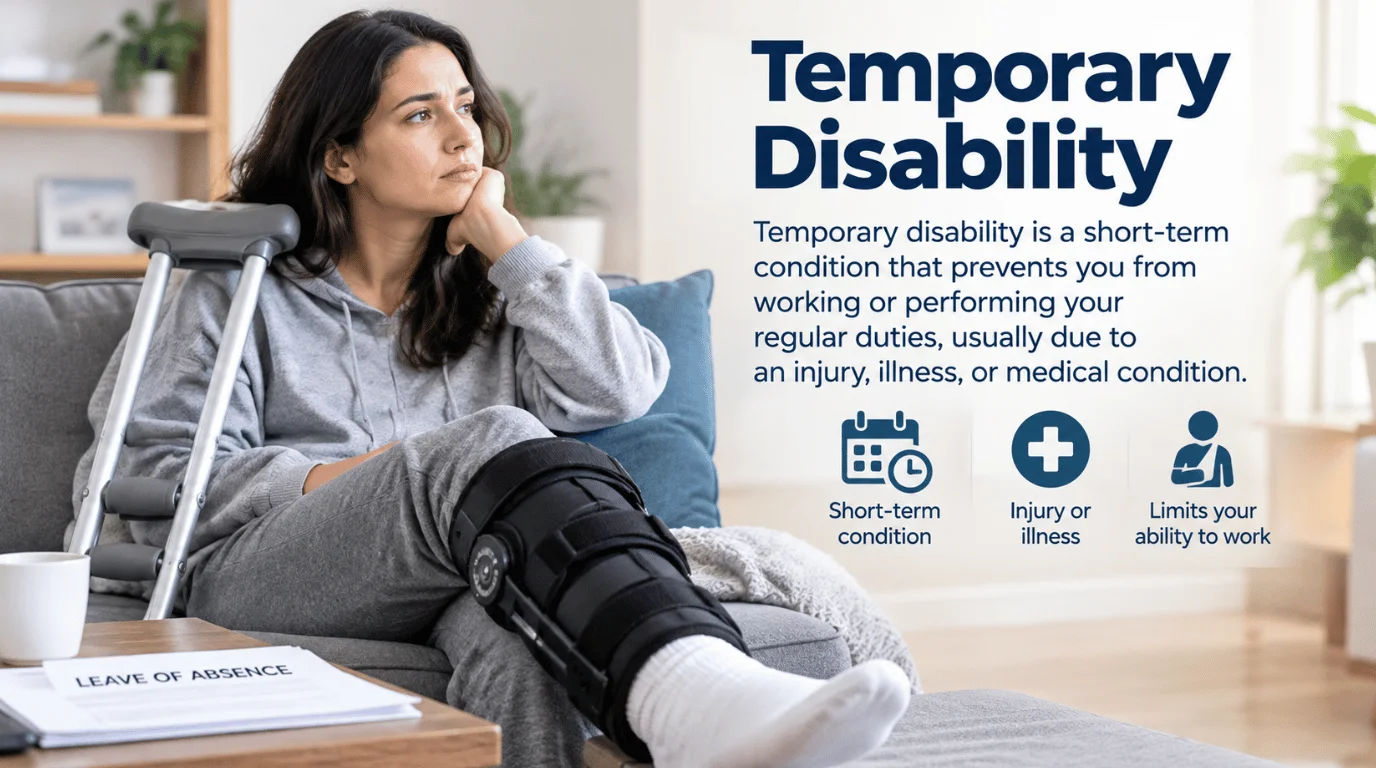
Temporary disability generally means a medical condition that prevents you from doing your job for a limited period while you are expected to recover. Depending on where you work and your benefits, income may come from a state disability program, employer-sponsored short-term disability insurance, or an individual policy rather than Social Security.
An unexpected illness, injury, surgery, pregnancy complication, or mental health condition can make working impossible even when recovery is expected. These benefits are designed to reduce the financial impact by replacing part of the income you lose while you cannot perform your job. However, the United States does not have one nationwide short-term disability program, so your benefits depend heavily on your state, employer, insurance coverage, medical documentation, and circumstances.
That distinction matters because disability pay, medical leave, and job protection are not the same thing. A program can replace some of your wages without guaranteeing that your position will remain available, while another law may protect your job without providing any pay. Understanding which programs apply to you can help you avoid filing with the wrong agency or assuming you have protections that your benefit plan does not actually provide.
What Is Temporary Disability?
The term describes a physical or mental health condition that prevents a person from performing their regular work for a limited period. The worker is generally expected to improve enough to return to work, although the exact definition varies among state programs and private insurance policies. Common examples include recovery from surgery, a serious illness, a broken bone, pregnancy-related incapacity, or a mental health condition that temporarily makes working medically impractical.
In benefits terminology, it usually refers to wage replacement, not payment of your medical bills. State disability insurance programs generally address non-work-related medical conditions, while workers’ compensation normally applies when an injury or occupational illness is connected to the job. Social Security Disability Insurance is different again because the Social Security Administration does not pay benefits for short-term or partial disabilities and generally requires a condition expected to last at least 12 continuous months or result in death.
Readers interested in the health side of returning to normal activities may also find Readlish’s coverage of postoperative recovery after spinal surgery useful. Recovery time can influence how long a healthcare professional certifies that someone cannot perform regular job duties. The benefit administrator or insurer, however, applies its own eligibility rules when deciding whether that period qualifies for payments.
How Does Temporary Disability Work?
The basic process is similar across many state and private programs. You become unable to work because of a covered medical condition, notify the appropriate employer or benefit administrator, and submit a claim supported by medical certification. If the claim satisfies the program’s earnings, coverage, waiting period, and medical requirements, you may receive a portion of your usual wages for an approved period.
A typical claim involves these steps:
- Confirm whether your coverage comes from a state program, an employer-sponsored short-term disability plan, or an individual policy.
- Notify your employer when required and ask which forms or claim administrator you should use.
- Obtain medical documentation showing why the condition prevents you from performing your work.
- Submit your claim within the program or policy deadline.
- Respond promptly if the agency or insurer asks for additional medical or employment information.
- Continue providing updated certification if your disability lasts longer than initially expected.
- Notify the benefit provider when you recover or return to work.
Benefits usually replace only part of your previous earnings rather than your full paycheck. Your plan can also impose a waiting period before payments begin, a maximum weekly payment, and a limit on the number of weeks you can collect. Because these provisions differ substantially, two workers with the same medical condition can receive very different amounts.
What Conditions Can Qualify?
There is no universal list of medical diagnoses that automatically qualifies someone for these benefits. What usually matters is whether a covered illness, injury, pregnancy-related condition, or mental health condition prevents you from performing your work and whether a qualified healthcare professional can support that restriction. A diagnosis alone may not be enough if you remain medically capable of carrying out your regular duties.
Potentially qualifying situations include the following.
- Recovery after a medically necessary surgery
- Serious infections or illnesses requiring time away from work
- Broken bones or other non-work-related injuries
- Complications related to pregnancy
- Recovery from childbirth where covered
- Cancer treatment or recovery periods
- Severe anxiety, depression, or other qualifying mental health conditions
- Medical conditions requiring treatment that temporarily prevent normal work
- Conditions requiring restricted hours or duties when the applicable program recognizes partial disability
Mental health conditions are not automatically excluded simply because symptoms are psychological rather than physical. For example, New Jersey explicitly states that its Temporary Disability Insurance program can cover physical or mental health conditions when they prevent an employee from working and the necessary medical certification is supplied. Eligibility still depends on the rules of the particular program or insurance policy.
Pregnancy can also qualify when a worker is medically unable to perform regular duties. California, for example, permits Disability Insurance claims when a licensed health professional certifies that pregnancy requires a person to stop working, reduce work hours, or change duties, including situations in which disability begins earlier than the usual pre-delivery period. The appropriate duration ultimately depends on the individual’s medical circumstances rather than pregnancy alone.
Which States Have Temporary Disability Insurance?

As of 2026, five states have mandatory state disability insurance systems for qualifying non-work-related disabilities: California, Hawaii, New Jersey, New York, and Rhode Island. Puerto Rico also has a temporary nonoccupational disability program, while the railroad industry has a separate federal sickness-benefit system. Most workers elsewhere in the country must instead look to an employer-sponsored plan, individually purchased coverage, paid leave, savings, or another applicable benefit.
2026 State Disability Benefits at a Glance
| State | Basic Benefit Structure | 2026 Maximum Weekly Benefit | Maximum Duration |
|---|---|---|---|
| California | Approximately 70% to 90% of qualifying wages, depending on income | $1,765 | Up to 52 weeks |
| Hawaii | Statutory plans generally pay 58% of average weekly wages. | $871 | Up to 26 weeks |
| New Jersey | 85% of average weekly wage, subject to the maximum | $1,119 | Up to 26 weeks |
| New York | 50% of the average weekly wage for the previous eight weeks | $170 | Up to 26 weeks in 52 weeks |
| Rhode Island | Benefit calculated from covered base-period wages | $1,150* | Up to 30 weeks |
*Rhode Island’s $1,150 maximum applies to new claims with an effective date of July 1, 2026, or later. Earlier 2026 benefit-year claims may remain subject to the previous $1,103 maximum. State rules, eligibility standards, and approved private-plan provisions can change, so applicants should verify their current benefit directly with the responsible state agency.
These figures also show why there is no meaningful nationwide answer to the question of how much these programs pay. New York’s statutory maximum is dramatically different from the maximum available in California. Individual earnings can also reduce a claimant’s actual benefit well below any state ceiling. A maximum weekly benefit is therefore a limit, not a promise that every approved applicant receives that amount.
How Much Does Temporary Disability Pay?
These benefits generally replace a percentage of prior wages up to a specified maximum. California estimates Disability Insurance benefits at approximately 70% to 90% of qualifying wages depending on income, while New Jersey pays 85% of the claimant’s calculated average weekly wage up to its annual maximum. Private short-term disability policies use their own formulas, so the policy certificate or summary plan description is the best place to confirm the actual replacement percentage.
Your previous earnings, payroll contributions, base period, employment history, other income, and policy limits can all affect the final amount. Some plans also coordinate benefits with workers’ compensation, paid leave, or other disability payments so that combined payments do not exceed an established limit. For that reason, an online estimate should be treated as a planning figure until the state agency or insurer issues an official benefit determination.
Taxes can also affect how much money ultimately reaches your household. The IRS explains that disability payments attributable to employer-paid accident or health insurance premiums are generally taxable, while benefits from a policy you paid entirely with after-tax money generally are not included in income. Mixed employer-and-employee funding can create partial taxability, so workers with significant benefits may want individualized tax guidance.
How Long Do Benefits Last?
The answer depends on the program rather than on a universal medical timeline. California Disability Insurance can provide benefits for as long as 52 weeks, while Hawaii, New Jersey, and New York generally cap statutory benefits at 26 weeks under their respective rules. Rhode Island permits qualified workers to collect up to 30 full weeks during the applicable benefit year.
The maximum duration does not mean every medical condition qualifies for benefits for that entire period. Payments can stop when your healthcare provider releases you to work, your approved disability period ends, you exhaust available benefits, or you otherwise cease to satisfy the program’s rules. Insurers and state agencies may also request updated medical information before approving an extension.
A condition that becomes long-term may eventually require a different benefits strategy. Social Security disability generally requires an impairment that has lasted or is expected to last at least 12 continuous months or result in death, which is why SSDI normally does not function as short-term income replacement. An employer’s long-term disability plan may have a shorter transition point, so check the elimination period and claim requirements before temporary or short-term coverage runs out.
Disability Pay vs. Other Benefits
Several U.S. programs can become relevant when a medical problem prevents you from working, but they solve different problems. Confusing them can result in missed deadlines or an assumption that receiving one benefit automatically gives you rights provided only by another law. The following comparison shows the most important differences.
| Program | Main Purpose | Usually Covers | Pays Income? | Automatically Protects Your Job? |
|---|---|---|---|---|
| Temporary disability / short-term disability | Replaces part of lost wages. | Usually non-work-related illness or injury | Yes, if eligible | Not necessarily |
| Workers’ compensation | Benefits for work-related injury or occupational illness | Conditions arising from employment | Usually | Rules vary by state. |
| FMLA | Protected family or medical leave | Qualifying serious health and family situations | FMLA itself is unpaid. | Yes, for eligible workers |
| ADA accommodation | Keep qualified workers with disabilities employed where reasonable. | Covered disabilities requiring workplace changes | Not primarily an income program | Provides employment rights, not wage replacement |
| SSDI | Federal income support for qualifying long-term disability | Severe conditions meeting Social Security standards | Yes. | No |
| Paid sick leave/PTO | Short absences from work | Employer or state-defined qualifying reasons | Usually | Depends on applicable law or policy |
The Family and Medical Leave Act (FMLA) can provide eligible employees of covered employers with up to 12 workweeks of unpaid, job-protected leave in 12 months. Qualifying reasons include a serious health condition that makes the employee unable to perform the job. FMLA can sometimes run at the same time as short-term disability or workers’ compensation because FMLA addresses leave and employment protection rather than disability-income insurance. The U.S. Department of Labor specifically notes that short-term or long-term disability benefits may run concurrently with FMLA leave.
Does Disability Pay Protect Your Job?
Receiving these payments does not automatically mean your job is protected. Income-replacement benefits answer the question of whether you can receive money while you are unable to work, while laws such as the FMLA and ADA address different employment rights. State leave laws, union agreements, employment contracts, and employer policies may provide additional protection.
FMLA protection depends on meeting its employee and employer eligibility requirements, so not every worker receiving disability benefits will qualify. Eligible workers can generally receive up to 12 workweeks of job-protected leave for their own qualifying serious health condition, and group health benefits must generally continue under the same conditions during covered FMLA leave. When the worker returns from qualifying FMLA leave, the law generally requires restoration to the same or a virtually identical position.
The Americans with Disabilities Act may offer another layer of protection for qualifying employees. Employers covered by the ADA may need to provide reasonable accommodations such as modified schedules, job restructuring, telework in appropriate circumstances, or disability-related leave unless the accommodation would create an undue hardship. A medical condition does not necessarily need to be permanent to receive ADA consideration, although whether a particular worker and condition qualify depends on the facts.
For more employment rights and legal topics, readers can explore the Readlish Law section. State employment protections can be broader than federal requirements, so local rules are particularly important in disability-leave situations. Workers facing possible termination, retaliation, or a disputed accommodation may benefit from obtaining advice appropriate to their state and circumstances.
How to Apply for Temporary Disability Benefits
Start by identifying the source of your coverage before filling out forms. Employees in California, Hawaii, New Jersey, New York, or Rhode Island should check the applicable state program and determine whether their employer uses a state fund, approved private plan, or another permitted arrangement. Workers elsewhere should ask human resources or their benefits administrator whether they have employer-sponsored short-term disability coverage and obtain the current plan documents.
Use this claim checklist:
- Confirm coverage. Review your pay stub, employee benefits portal, insurance certificate, or state program information.
- Report your absence. Follow your employer’s normal call-in and medical-leave procedures unless an emergency prevents you from doing so.
- Record the first day you could not work. Benefit calculations and waiting periods often depend on the disability start date.
- Contact your healthcare provider. Ask whether the provider can certify your functional limitations and expected recovery period.
- File with the correct administrator. This may be a state agency, insurance company, third-party claims administrator, or employer-approved private plan.
- Submit supporting documents promptly. Missing medical certification or employment information can delay a decision.
- Track the claim. Save confirmation numbers, letters, medical forms, and records of communications.
- Request an extension when medically necessary. Do not assume an initial approval automatically continues until you feel ready to return.
- Coordinate leave and job protection separately. Ask whether FMLA, state leave law, ADA accommodation, PTO, or another policy also applies.
Medical certification is especially important because benefit administrators need evidence that your health condition actually limits your capacity to work. New Jersey, for example, requires a healthcare provider to certify how long recovery is expected to take, while California requires physician or practitioner certification for Disability Insurance claims. A complete claim should focus not only on the diagnosis but also on how the condition affects the work you are expected to perform.
Filing deadlines should also be treated seriously. Different states and private policies impose different reporting and claim deadlines, and waiting too long can complicate eligibility even when the underlying condition is legitimate. Review the official instructions applicable to your plan rather than assuming that the deadline used by another state or employer applies to you.
What If Your Claim Is Denied?
A denial does not necessarily mean the medical condition is insignificant. Claims may be rejected because of insufficient wages, lack of coverage, missing medical information, late filing, an exclusion in the policy, disagreement over whether the claimant can perform the job, or failure to satisfy another technical requirement. The first step is to read the denial notice carefully and identify the precise reason given.
After a denial, consider checking the following points.
- Whether your earnings or employment records are accurate
- Whether the correct medical records were submitted
- Whether your healthcare provider clearly described your functional restrictions
- Whether the insurer applied the correct definition of disability
- Whether the claim was filed within the required period
- Whether another benefit program is responsible for the condition
- Whether the denial notice provides an appeal deadline and evidence requirements
Appeal procedures vary between state programs and private plans, so follow the instructions in the decision rather than sending a general request for reconsideration. Keep copies of every submission and note important deadlines because appeal rights can be lost when a required response is late. When substantial income or employment rights are at stake, consider speaking with an appropriate benefits or employment-law professional rather than relying solely on general online information.
Frequently Asked Questions
Is temporary disability the same as short-term disability?
The terms are often used interchangeably, but their meaning depends on context. “Temporary disability insurance” commonly describes state-mandated programs in places such as New Jersey and Rhode Island, while “short-term disability” often refers to an employer-sponsored or individually purchased insurance policy. Both can replace income during a limited medical absence, but their eligibility rules and benefit formulas can be very different.
Can I get disability benefits for anxiety or depression?
Potentially, yes, when a mental health condition prevents you from working, and the applicable program covers the condition. New Jersey expressly recognizes qualifying physical and mental health conditions under its TDI program, and private policies may also cover mental health disabilities subject to their terms. Medical documentation explaining your symptoms, treatment, functional restrictions, and inability to perform required duties can be important.
Can I receive benefits after surgery?
Yes, surgery and the medically necessary recovery period can qualify under many temporary or short-term disability programs when the procedure leaves you unable to perform your job. Approval is not based merely on having undergone an operation because the insurer or agency will normally evaluate how long you are medically unable to work. Recovery needs can differ significantly depending on the procedure, job duties, complications, and individual medical circumstances.
Can pregnancy qualify for benefits?
Pregnancy-related incapacity and recovery from childbirth can qualify under certain state and private disability programs. California allows Disability Insurance when a licensed health professional certifies that a worker cannot perform regular work due to pregnancy, and New Jersey includes pregnancy and childbirth recovery within its TDI framework. The exact period of eligibility depends on medical certification and the program’s rules rather than a single nationwide pregnancy-benefit schedule.
Can I work part-time while receiving benefits?
Some programs permit partial benefits when a healthcare professional allows reduced work and the claimant continues to meet program requirements. California notes that people working part time during disability may still qualify, although benefits can be reduced when wages plus disability payments exceed regular weekly wages. Never assume part-time work is permitted without reporting it because unreported earnings can affect eligibility or create an overpayment.
Can I collect Social Security for a short-term condition?
Social Security does not pay disability benefits for short-term or partial disability. To meet the federal Social Security definition, a qualifying impairment generally must prevent substantial work and have lasted or be expected to last for at least 12 continuous months or result in death. Workers expecting a shorter recovery should instead investigate state disability insurance, employer-sponsored coverage, private insurance, workers’ compensation when the condition is job-related, and applicable leave benefits.
Does getting disability pay mean my employer cannot fire me?
Not automatically, because disability-income benefits and job-protection laws serve different purposes. FMLA, the ADA, state laws, contracts, or employer policies may protect a qualifying employee even though the disability insurance policy itself does not guarantee continued employment. Anyone concerned about losing a job during medical leave should determine which employment protections apply at the same time they file for wage-replacement benefits.
The Bottom Line
Temporary disability can provide crucial income when a medical condition temporarily takes you out of the workforce, but there is no single U.S. program or benefit amount that applies to everyone. Your best starting point is to identify whether you have state-mandated coverage, an employer-sponsored short-term disability plan, or individual insurance and then coordinate that income benefit with any FMLA, ADA, state-leave, or workers’ compensation rights that may apply. Confirm current requirements directly with the relevant agency, insurer, employer, or qualified professional before making financial or employment decisions.